

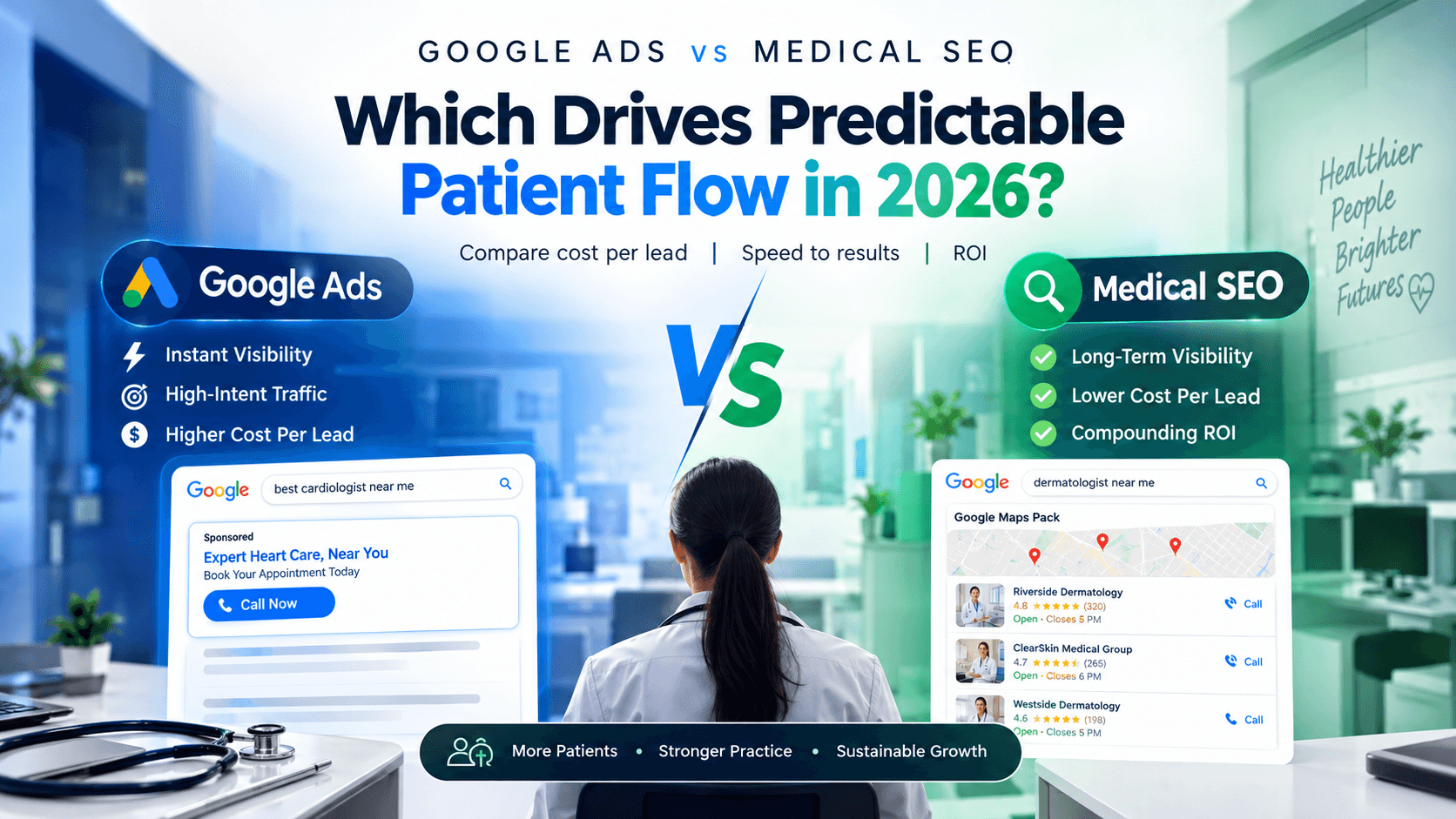

Google Ads vs Medical SEO: Which Drives Predictable Patient Flow in 2026?
Every clinic owner and practice administrator faces the same challenge: how to keep patient flow steady without letting acquisition costs spiral. Referrals and word of mouth alone are no longer enough, because most prospective patients start their search on Google. They look up symptoms, compare providers, read reviews, and decide on an appointment in minutes.
That leads to the central question: should your practice invest in Google Ads, medical SEO, or both? The two channels work on very different economics. Below, we compare them on cost per lead, time to results, and ROI.
Quick Answer: Google Ads or Medical SEO?
- Choose Google Ads if you need appointments within days, such as a new location or a new procedure launch.
- Choose medical SEO if you want the lowest cost per lead over 12 months or more.
- Use both for the most predictable patient flow. Ads bring immediate bookings while SEO builds long-term visibility.
Google Ads for Medical Practices: Instant Visibility at a Price
When time matters, Google Ads is the fastest option. By bidding on high-intent searches, a practice can appear at the top of Google search results within 24 to 48 hours of launching a campaign.
Why Are Google Ads So Expensive for Doctors?
Healthcare has some of the highest cost-per-click (CPC) rates in digital advertising. Terms like "urgent orthopedic surgeon near me" or "emergency dentist appointment" can cost anywhere from $15 to over $65 per click. Three factors drive this:
- High patient lifetime value: A surgical or long-term orthodontic patient is worth thousands of dollars, so hospital networks and private equity-backed groups bid aggressively.
- Competition for symptom searches: Competitors constantly outbid each other for high-intent local searches.
- Wasted spend from missing negative keywords: Self-managed campaigns often pay for clicks from people looking for free clinics, general symptom information, or medical school programs.
Working with a team that offers Google Ads services for healthcare providers helps cut this waste through strict negative keywords, geo-targeting, and HIPAA-aware campaign setup. Note that Google also restricts remarketing based on sensitive health information, so compliance matters.
3 Google Ads Optimization Rules for Doctors in 2026
In 2026, Local Services Ads (Google Screened) can appear above standard text ads for some specialties, followed by paid results and then organic listings. To keep cost per lead under control:
- Build condition-specific ad groups. Group keywords by treatment (e.g., "torn meniscus treatment") rather than broad terms like "knee doctor".
- Prioritize click-to-call. Many patients, especially for urgent care, prefer calling the front desk from a mobile ad over filling out a form.
- Send traffic to dedicated landing pages. A treatment-specific page converts better than a generic homepage. A fast, conversion-focused medical website design makes a big difference here.
Medical SEO: Compounding Returns and Long-Term Authority
Google Ads is like renting: when you stop paying, visibility disappears. Medical SEO is more like owning. It takes upfront work, but the returns compound and your average acquisition cost drops over time.
Why the Google Map Pack (3-Pack) Matters for Clinics
For "near me" searches, patients focus on the Google Map Pack. Ranking in the top three local results gives you credibility and high-intent traffic without paying per click. To get there, you need:
- A complete, verified Google Business Profile with the right categories.
- Consistent Name, Address, and Phone (NAP) details across directories like Healthgrades, Vitals, and WebMD.
- A steady flow of patient reviews that naturally mention your services.
Specialized medical SEO services build these local signals along with schema markup and E-E-A-T (experience, expertise, authoritativeness, trustworthiness).
How to Do SEO for a Medical Practice: A 4-Step Framework
If you are wondering how to do SEO for a medical practice, focus on these four pillars.
Step 1: Fix Technical Basics and Core Web Vitals
Slow sites lose patients. If your site takes more than 3 seconds to load on mobile, a large share of visitors will go back to the search results. Fast loading, mobile-friendly design, and clean code are your baseline.
Step 2: Build Condition and Procedure Content Clusters
Do not list a dozen treatments on one "Services" page. Create a dedicated, in-depth page for each major procedure, supported by related articles. Specialty practices see this work well, for example through procedure-focused hubs built for orthopedic marketing services.
Step 3: Strengthen E-E-A-T for YMYL Content
Google holds health content to strict "Your Money or Your Life" (YMYL) standards. Every medical article should include:
- Author bylines naming qualified medical professionals.
- Clear review notices and publication or update dates.
- Links to peer-reviewed research and trusted sources such as the U.S. Department of Health & Human Services for privacy and compliance topics.
Step 4: Optimize for Booking Conversion
Traffic only matters if it turns into appointments. Add clear click-to-call buttons, a simple online booking form, and integration with your practice management software. When intake is digital, patient flow becomes easier to predict and manage.
Google Ads vs Medical SEO: Head-to-Head Comparison
Metric
Google Ads for Healthcare
Medical SEO
Speed to first appointment
24–48 hours
3–6 months
Average cost per lead
Moderate to high (40–180+, varies by specialty)
Lower over time (15–~$ 45 USD)
Ongoing cost
Continuous ad spend
No per-click cost
Where you appear
Top of results (sponsored)
Map Pack and organic listings
Click share
Smaller share of clicks
Larger share of clicks
Scalability
Instant, by raising budget
Gradual, through authority and content
The 2026 Hybrid Strategy: Combine Google Ads and SEO
The best practices do not choose one over the other. A simple three-phase plan works well:
- Months 1–3: Launch targeted Google Ads for immediate appointments and cash flow.
- Months 3–6: Use your Google Ads keyword and conversion data to build SEO pages that target proven, high-converting terms.
- Months 6–12+: Grow organic rankings and gradually reduce dependence on paid ads.
For a broader look at how these channels fit together, read our complete healthcare digital marketing guide or see how smart practices approach digital advertising in 2026. You can also explore our full range of healthcare marketing services.
Frequently Asked Questions
Which has a lower cost per lead: medical SEO or Google Ads?
Over 12 months, medical SEO usually delivers a lower cost per lead. Google Ads charges for every click, while SEO assets keep bringing in patients without per-click fees.
How long does medical SEO take to show results?
Many clinics see gains in Map Pack rankings and impressions within 60 to 90 days. Growth in booked appointments typically builds between months 4 and 6 as content and authority expand.
Can a new clinic rely on Google Ads alone?
Ads can fill an initial schedule quickly, but relying on them alone leaves you exposed to rising costs and budget limits. Most sustainable clinics use ads for early cash flow while building an organic foundation.
Is medical SEO or Google Ads better for a new clinic?
Start with Google Ads to get patients quickly, and begin SEO at the same time so organic results are ready to take over as ad costs rise.
Can I run Google Ads and SEO at the same time?
Yes, and it is recommended. Ads data shows which keywords convert, and that insight helps you prioritize SEO content.
-1.png&w=1080&q=75)