


Medical Practice Marketing: Strategies, Budget & Cost Breakdown for 2026
Excellent clinical care is the foundation of every practice, but it no longer fills a schedule on its own. Before a patient ever calls your front desk, they have searched Google, compared reviews, and looked at your website. If your practice isn't visible and trustworthy at that moment, they book somewhere else.
This guide explains how medical practice marketing works in 2026. You'll see which strategies are worth your attention, how much to budget at each stage of your practice, what each service typically costs, and how to tell whether your spend is working.
For a wider overview of the field, see our Healthcare Digital Marketing guide.
What Is Medical Practice Marketing?
Medical practice marketing is everything a clinic does to get found by the right patients, earn their trust, and turn interest into booked appointments. It also includes keeping current patients engaged so they return and refer others.
It works differently from marketing in most industries:
- Trust drives the decision. Patients weigh reviews, credentials, and the physician's reputation, not just price.
- Compliance matters. Content, ads, and tracking must respect HIPAA and healthcare advertising rules.
- Specialties behave differently. An orthopedic patient researching a joint replacement searches and decides very differently from someone booking a cosmetic treatment.
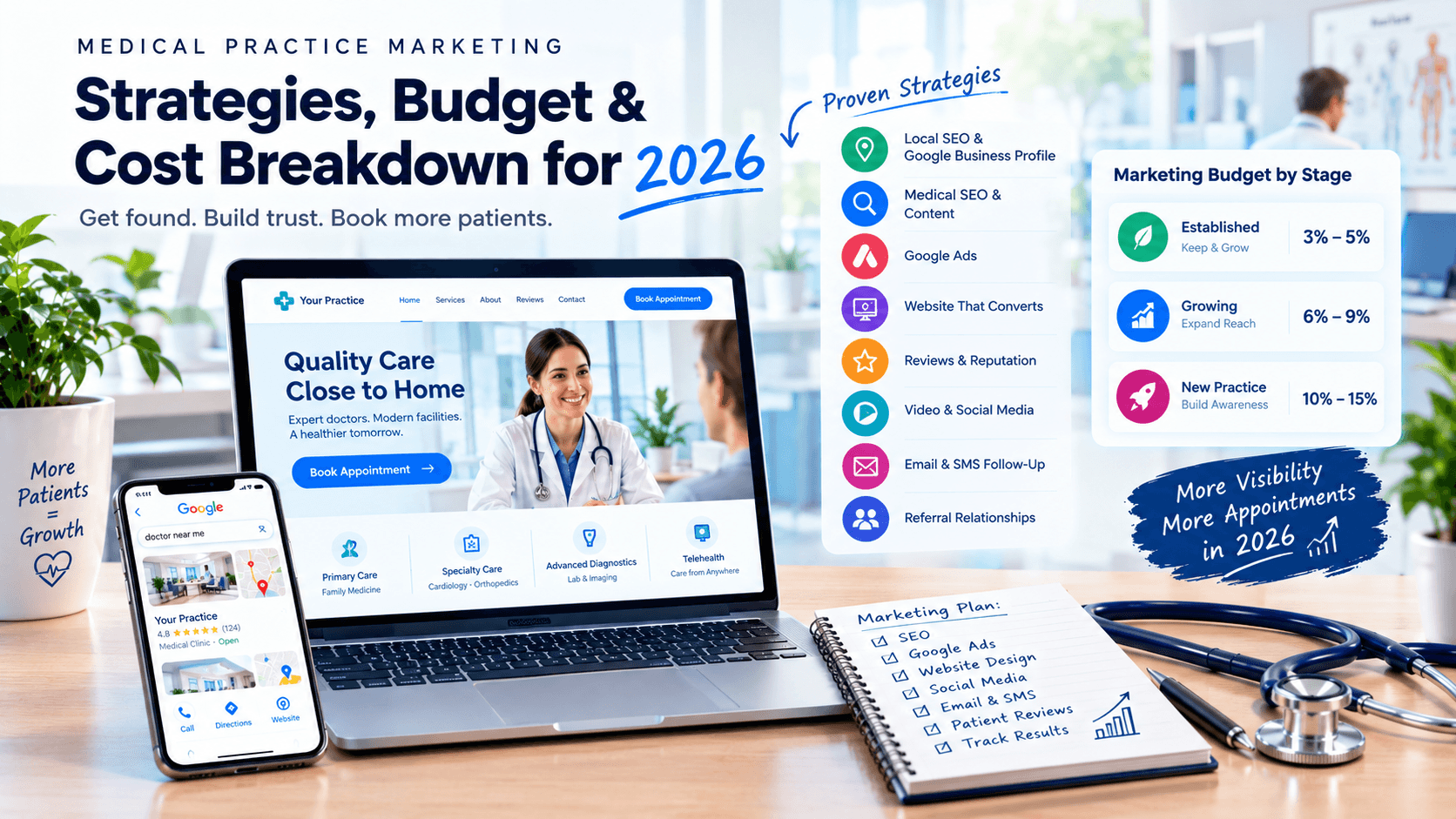
8 Strategies for Marketing a Medical Practice in 2026
1. Local SEO and Google Business Profile
Most patients search for care near them, so map results often bring more calls than standard listings. Keep your Google Business Profile complete, with accurate hours, services, photos, and replies to reviews, and make sure your name, address, and phone number match everywhere online.
2. Medical SEO and Content
Treatment pages, condition guides, and clear answers to patient questions help you rank for the searches that lead to appointments. Medical content is held to a high standard by Google, so it should be accurate, reviewed by a qualified clinician, and clearly attributed. SEO builds slowly but keeps paying off after the work is done. Our medical SEO services combine local optimization, condition-specific content, and technical SEO.
3. Google Ads
Paid search puts you in front of patients who are searching right now. It suits new practices, new service lines, and competitive areas where rankings take time. The best campaigns target specific treatments and locations instead of broad terms. See our Google Ads services for healthcare providers.
4. A Website That Converts
Your website is your digital front door. It should load fast, work on mobile, state your services clearly, and make booking easy. Traffic only helps if visitors can take the next step. Learn more about our healthcare website design services.
5. Reviews and Reputation
Patients read reviews before they read your site. Ask satisfied patients for feedback soon after their visit, reply to every review professionally, and never include health details in a public reply.
6. Video and Social Media
Short videos of physicians explaining a condition or procedure make a practice feel familiar. Social media usually builds trust and brand recall more than it drives direct bookings, and it works especially well for elective and cosmetic services. Explore social media marketing for healthcare and healthcare video marketing to turn physician expertise into patient trust.
7. Email and SMS Follow-Up
Appointment reminders, recall campaigns, and educational newsletters bring existing patients back. Retaining a patient is almost always cheaper than winning a new one.
8. Referral Relationships
Referring physicians and satisfied patients remain valuable. Treat them as one channel in a mix, not your only source of new patients, so your schedule doesn't depend on a few relationships.
How Much Should a Medical Practice Spend on Marketing?
There is no single correct figure, but a share of revenue gives a useful starting point. The right percentage depends mostly on your stage.
Practice stage
Typical share of revenue
What it covers
Established, steady schedule
About 3% to 5%
Protect visibility, keep patients returning
Growing, adding providers or services
About 6% to 9%
Ongoing new patient acquisition
New practice or new market
About 10% to 15%
Build awareness while schedules fill
These are general planning ranges, not rules. Competition, specialty, and location all move the number.
What changes your budget
- Specialty: high-value procedures can justify more spend per patient.
- Competition: a crowded city costs more than a small town.
- Starting point: a practice with no reviews or a weak website needs more upfront.
- Goals: doubling patient volume needs a different budget than maintaining it.
A practical way to set it: decide how many new patients you want each month, estimate what an average patient is worth, and work backwards to what you can afford to spend to acquire one.
What Does Medical Practice Marketing Cost?
Figures below are typical market ranges. Your actual price depends on scope, location, and specialty. Agency fees and ad spend are separate costs.
Service
Typical cost
Notes
Medical SEO
$1,500 to $5,000 per month
Ongoing. Results usually build over 3 to 6 months.
Google Ads management fee
Flat monthly fee or a percentage of ad spend
Paid to the agency.
Google Ads spend
$1,500 to $5,000+ per month
Paid directly to Google.
Website design
$3,500 to $25,000+ one time
Depends on pages, design and features.
Social media and video
$1,000 to $3,000 per month
Varies with volume and editing.
Reputation management
$200 to $500 per month
Review requests and monitoring.
In-house team or agency?
An in-house coordinator typically costs $55,000 to $75,000 a year plus benefits and software, and one person rarely covers SEO, paid ads, design, development, and HIPAA compliance alone. An agency gives access to a team of specialists, and many practices use a hybrid approach, with an agency for technical work and a staff member for day-to-day coordination.
Option
Strength
Trade-off
Agency
Full skill set, faster start
Less day-to-day control
In-house
Close control, knows the practice
Higher fixed cost, limited skills
Hybrid
Balanced
Needs good coordination
If you'd like help comparing options, see our medical marketing services.
Patient Acquisition Cost, Lifetime Value and ROI
Three numbers tell you whether your marketing is paying off.
Patient acquisition cost (PAC) is your marketing spend divided by the new patients it brings in. If you spend $3,000 in a month and gain 30 new patients, your PAC is $100. Track cost per booked patient, not just cost per lead.
Patient lifetime value (LTV) is the total revenue an average patient brings over the whole relationship. A primary care patient who visits twice a year for checkups and testing can be worth roughly $2,500 or more over time. A patient who needs a specialized procedure, such as a joint replacement, can represent $4,000 to $15,000 or more.
Return on investment (ROI) follows from the two. When lifetime value is well above acquisition cost, growth becomes predictable. PAC varies widely by specialty, so compare your own numbers against your own patient value rather than a general average.
Common Mistakes in Medical Practice Marketing
- Running ads to a website that doesn't convert. Fix the site first, or you pay for clicks that never book. See our guide on why your medical website isn't converting.
- Ignoring Google Business Profile. It is often the fastest local win.
- Using one plan for every specialty. What fills a med spa schedule won't necessarily fill an orthopedic one.
- Not tracking calls and bookings. If you can't tell which channel produced a patient, you can't spend wisely.
- Expecting SEO overnight. It compounds over months. Pair it with ads when you need faster results.
- Splitting the budget evenly across every channel. Put more behind what produces booked patients.
- Choosing an agency with no healthcare experience. Compliance and patient behavior in medicine are different from retail.
How to Measure Results
Review a small set of numbers every month:
- New patient inquiries (calls, forms, bookings)
- Cost per lead and cost per new patient
- Conversion rate from inquiry to booked appointment
- Source of each new patient
- Return on ad spend for paid campaigns
Use call tracking and form tracking so every inquiry is tied to its source, then shift budget toward what works.
Marketing Examples by Specialty
- Orthopedic marketing: long research cycles, so educational content and strong local rankings matter.
- Dermatology and med spa marketing: visual proof, reviews, and social video carry more weight.
- Fertility clinic and urology marketing: sensitive topics, so trust-building and privacy-aware content come first.
- Plastic surgery marketing: high-value decisions, so consultations, before and after content (within advertising rules), and reputation are central.
Frequently Asked Questions
How much should a medical practice spend on marketing?
Many practices plan roughly 3% to 5% of revenue when established, 6% to 9% when growing, and 10% to 15% when launching. The right figure depends on your specialty, competition, and goals.
How much does medical practice marketing cost per month?
Costs vary widely. Medical SEO often runs $1,500 to $5,000 per month, and Google Ads spend commonly starts around $1,500 per month on top of management fees. A custom website is a one-time cost.
How long does it take to see results?
Google Ads can bring inquiries within days of launch. SEO and reputation building usually take 3 to 6 months to show steady gains.
Is Google Ads worth it for a medical practice?
It can be, especially for new service lines and competitive areas, as long as campaigns target specific treatments and your website converts visitors into appointments.
Should I hire an agency or build an in-house team?
Agencies offer a broader skill set and a faster start. In-house gives closer control at a higher fixed cost. Many practices combine both.
Can I do medical practice marketing myself?
You can handle basics such as your Google Business Profile and review requests. SEO, ads, and tracking usually benefit from specialists, particularly because of HIPAA and advertising rules.
-1.png&w=1080&q=75)