

-1.png&w=3840&q=75)

Healthcare Social Media Marketing Guide for Clinics (2026)
Healthcare social media marketing is how a medical practice earns patient trust before the first phone call. While deciding who to book, patients look at your Facebook page, your Instagram, and your reviews. The practice that looks clear, caring, and consistent usually wins that comparison.
Healthcare is not retail, though. You cannot post a patient photo without written permission; you cannot promise results, and you cannot answer a bad review the way a café would. That is why generic social media advice so often fails clinics.
This guide is for practice owners, administrators, and marketing managers. It covers how to build a healthcare social media strategy, what to post, how to follow HIPAA, which tools and ads to use, what it costs, and when to bring in help. Social media is one channel in your wider healthcare digital marketing plan, so read the two together.
Table of Contents
- Key Takeaways
- What Is Healthcare Social Media Marketing?
- Why Social Media Matters for Medical Practices
- Healthcare Social Media Strategy: 5 Steps
- Social Media Marketing for Doctors
- Healthcare Social Media Content Ideas
- What to Post on Social Media for a Medical Practice: A 4-Week Calendar
- Patient Education and Patient Engagement
- HIPAA Social Media Guidelines for Medical Practices
- Healthcare Social Media Management: Workflow and Tools
- Facebook Ads vs Instagram Ads for Doctors
- How Much Does Social Media Management Cost for a Medical Practice?
- In-House vs Agency Social Media for Clinics
- Common Healthcare Social Media Mistakes to Avoid
- Your First 30 Days: A Launch Checklist
- Tracking Social Media Results
- FAQs
Key Takeaways
- Choose one goal, one or two platforms, and four or five content pillars before you post anything.
- Educate first. Patient education builds trust faster than promotion.
- Never post patient information without written authorization, and never confirm that someone is a patient in a review reply.
- Measure booked appointments, not likes.
- Start small. Two to three posts a week for 90 days beats a daily burst that fades.
What Is Healthcare Social Media Marketing?
Healthcare social media marketing is the use of platforms such as Facebook, Instagram, LinkedIn, and YouTube to educate patients, build trust in your practice, and stay visible while people choose a provider, all within privacy and advertising rules. It covers organic posting, community management, and paid social ads.
Four things set it apart from marketing in other industries:
- Trust comes first. Patients are choosing someone to treat their body, so credibility matters more than clever content.
- Privacy rules apply. HIPAA limits what you can share about patients, including photos, names, and even the fact that someone is a patient.
- Claims are regulated. Guarantees, before-and-after promises, and misleading testimonials can break advertising and medical board rules.
- Decisions take time. Many patients research for weeks and compare several practices before they call.
Why Social Media Matters for Medical Practices
Social media marketing for medical practices matters because patients use it to judge trust, not just to scroll. Before booking, people want to see who you are, how you explain things, and whether other patients seem satisfied.
- It builds trust before the visit. A short video of a surgeon explaining recovery often calms nerves better than a services page. Patients who have seen your team on screen arrive more relaxed.
- It keeps you visible during a long decision. Patients rarely book after one search. Regular posts keep your practice in mind while they compare options and talk to family.
- It supports referrals. Referring doctors and patients’ families often look you up before they recommend you. A clear, current profile removes doubt.
- It works alongside search. Patients who find you on Google usually check your profiles next, so keep your look and message consistent in both places. A clear brand for your practice makes that easier, and strong medical SEO helps patients find you in the first place.
Healthcare Social Media Strategy: 5 Steps
A healthcare social media strategy is a short written plan that answers five questions: what you want, who you are talking to, where you will post, what you will say, and how you will know it works. Without one, posting becomes random and hard to sustain.
Step 1: Pick One Goal
Choose the main result you want in the next 90 days. Good goals are specific, such as increasing consultation requests from Instagram by 20% or earning 10 new patient reviews a month. One goal keeps every post focused. Common goals are appointment requests, awareness of a new service, review growth, and engagement from current patients.
Step 2: Know Who You Are Talking To
Most practices speak to three groups: patients researching care, family members or caregivers who help them decide, and referring doctors. Write one short profile for each. A 55-year-old with knee pain wants to know about recovery time and cost, while the adult daughter helping them wants to know whether your clinic is trustworthy and easy to reach.
Step 3: Choose One or Two Platforms
Steady posting on two platforms beats irregular posting on five. Pick the platforms where your patients already are and where your team can keep up.
- Facebook: local community, events, and reviews. Event posts, team news, patient education, local updates.
- Instagram: visual trust-building. Reels, carousels, behind-the-scenes clips, team introductions.
- LinkedIn: referral relationships and professional credibility. Physician profiles, practice news, research summaries.
- YouTube: detailed procedure and recovery explainers. Two-to-five-minute videos and Shorts clips.
- TikTok: practices with confident on-camera staff. Short myth-busting and Q&A videos.
Step 4: Set Your Content Pillars
Content pillars are four or five themes that every post fits into, so you never start from a blank page. A clinic can begin with this mix:
- Patient education (about 40%): conditions, symptoms, recovery, and when to see a specialist.
- Meet the team (about 20%): surgeon and staff introductions, credentials, a day in the clinic.
- Procedures explained (about 20%): what happens before, during, and after a visit.
- Patient stories (about 10%): only with written consent.
- Practice updates and community (about 10%): new services, hours, events, and health awareness days.
These percentages are a starting point. Adjust them as you learn what your audience responds to.
Step 5: Decide How You Will Measure
Pick numbers that connect to appointments: profile clicks, inquiries, and bookings from social traffic. The tracking section near the end of this guide shows how.
Social Media Marketing for Doctors
Social media marketing for doctors works best when the practice account carries the schedule and the physicians appear in the content. Doctors rarely have time to post daily, and they do not need to. People still follow people, so a doctor’s face and voice matter.
- Practice account: the main channel. Staff or a marketing partner post on a fixed schedule.
- Physician appearances: a 60-second video, a Q&A, or a quoted tip, recorded in one batch each month.
- Personal physician profiles: optional. If doctors use them, the same patient-privacy rules and professional guidelines apply, and personal and practice content should stay clearly separate.
A Simple Monthly Video Routine
Block 60 to 90 minutes once a month and film six to eight short clips back to back, each answering one patient question, such as what to expect at a first visit or how long recovery takes. Give every clip the same outline: a one-line hook that states the question, a plain-language answer, and a next step such as calling the office. Add captions, because many people watch with the sound off. If filming and editing take too much time, video marketing and editing support can handle it.
Keep Doctors Involved Without Slowing Posts Down
Use a three-step approval flow. Marketing drafts the post, a clinician checks medical accuracy, and a compliance contact approves anything involving a patient. Do not promise specific outcomes in any post, and keep a short log of what was approved.
Healthcare Social Media Content Ideas
The best healthcare social media content ideas answer a question a patient is already asking. Start with the questions your front desk and consult rooms hear most, keep a running list, and turn each one into a post. Here are ideas for every pillar.
Patient education
- Five signs it is time to see a specialist
- A week-by-week recovery timeline for a common procedure
- Myth vs. fact about a condition you treat
- What to ask at your first appointment
Meet the team
- A surgeon explains why they chose the specialty
- A day in the life of your front desk or nursing team
- Credentials and areas of focus, in plain language
Procedures explained
- What happens on consult day
- A checklist for preparing for surgery
- Aftercare steps and when to call the office, with no promised results
Patient stories (with written consent)
- A short quote or video about the experience, not the diagnosis
- “What I wish I had known before my visit”
Community and updates
- New hours, a new location, or a new service
- Health awareness days and local events
- Seasonal tips, such as sports injuries in the fall
A Caption Formula That Works
Write captions in three parts: a hook that names the patient’s question, a useful answer in two or three short lines, and one clear next step. For example: “Does knee pain on the stairs always mean surgery? Not always. Here are three signs it is time to get it checked. Save this post, and call us if you notice any of them.”
Your specialty changes the mix. Our orthopedic marketing strategies show how procedure-led content works, and the complete guide to dermatology marketing shows how medical and cosmetic content can run side by side. Med spa marketing leans harder on visual content, within advertising rules.
What to Post on Social Media for a Medical Practice: A 4-Week Calendar
Use this as a starting rhythm of three posts a week, then adjust to what your patients respond to.
- Week 1: Monday, patient education tip (carousel). Wednesday, meet the team (photo). Friday, a common question answered in a 30-second video.
- Week 2: Monday, myth vs. fact. Wednesday, procedure explained. Friday, community or awareness-day post.
- Week 3: Monday, recovery tips (carousel). Wednesday, surgeon Q&A (video). Friday, practice update or new service.
- Week 4: Monday, a question from a recent consult. Wednesday, behind the scenes at the clinic. Friday, a consented patient story or a review reply.
Two to three posts a week on one or two platforms is a realistic start. Reuse every idea: one article can become a carousel, a short video, and an email snippet.
Patient Education and Patient Engagement
Patient education is your strongest content, and patient engagement is what happens when people respond to it. Education earns trust. Engagement turns that trust into conversations and, over time, appointments.
How to Make Patient Education Posts Work
- Use plain language. Health literacy guidance commonly recommends writing for a general audience, roughly at a sixth- to eighth-grade reading level. Explain any medical term in one sentence.
- Answer one question per post. A post that tries to explain everything usually explains nothing.
- Have a clinician review it. Check every medical statement before it goes live.
- Link to the next step. Send readers to the matching service page or article so interest becomes action.
How to Encourage Patient Engagement
- Ask a question in the caption, such as what you should explain next.
- Use Story polls and question boxes to collect topics.
- Reply to comments and messages within one business day.
- Move private health questions to a phone call or a secure portal, never the comments or direct messages.
A safe reply to a private health question might read: “Thank you for reaching out. For your privacy, we cannot discuss health details here. Please call our office, and we will be glad to help.” Save it as a template so every staff member uses the same wording.
Engagement is also part of the wider patient journey. See 10 ways medical digital marketing improves the patient experience from first search to follow-up care.
HIPAA Social Media Guidelines for Medical Practices
HIPAA social media guidelines come down to one rule: do not share protected health information (PHI) without the patient’s written authorization. Photos, names, treatment details, and even confirming that someone is your patient can all count.
This is not just theory. In December 2022, the U.S. Department of Health and Human Services announced a settlement with a California dental practice that disclosed patient information while replying to online reviews. The practice paid $23,000 and agreed to a corrective action plan monitored for two years.
Practical Rules for Social Media
- Get written authorization first. Before posting a patient’s photo, video, story, or testimonial, get signed permission. A casual yes is not enough, and the patient should be able to withdraw it.
- Do not confirm patient status in review replies. A patient may discuss their own care in a public review, but you may not. Reply with a general message and invite them to contact you offline.
- Keep private conversations private. Comments and direct messages are not a safe place for PHI. Move them to a phone call or a secure portal.
- Check the background. Charts, screens, wristbands, and name tags in staff photos can reveal PHI.
- Avoid guarantees and misleading claims. FTC rules on endorsements and testimonials, plus your state medical board’s advertising rules, also apply.
- Write a short staff policy. State who can post, what is off limits, and who approves, and train staff on it every year.
A Safe Way to Reply to a Negative Review
Keep the reply general, calm, and free of any detail about care. For example: “Thank you for your feedback. We take every concern seriously. For privacy reasons, we cannot discuss any individual’s care in a public forum. Please call our office so we can listen and help.” This confirms nothing about the reviewer and invites a private conversation.
What a Photo or Testimonial Authorization Should Cover
A valid authorization generally states what will be shared, who will share it, where it will appear, and for how long. It also explains the patient’s right to revoke it and carries a signature and date. Have a healthcare attorney draft or review your form.
Your marketing tools matter too. Tracking pixels and analytics on pages where patients book or enter health details can create compliance risk, so review them with your compliance contact.
This section is general information, not legal advice. Confirm your policies with a healthcare attorney or compliance officer.
Healthcare Social Media Management: Workflow and Tools
Healthcare social media management is a routine, not a one-off task: plan, create, approve, schedule, respond, and report. A simple workflow looks like this:
- Monthly: plan the calendar and batch-film physician videos.
- Weekly: create and design posts, then get clinical review.
- Before publishing: run a compliance check, then schedule.
- Daily, about 10 minutes: reply to comments and messages.
- Monthly: review results and adjust the plan.
Assign an owner to each step. In a small practice, one staff member can own the schedule, a physician reviews medical accuracy, and the practice manager or compliance contact gives final approval. Write it down so the routine continues when someone is on leave.
Best HIPAA-Compliant Social Media Management Tools: What to Look For
No scheduling tool makes a practice HIPAA-compliant on its own. Compliance depends on what you post and who can see it, and public posts should never contain PHI. Still, when comparing tools, check for these features:
- Role-based access: limits who can publish and who can read inboxes.
- Approval workflow: lets a clinician or compliance contact sign off before a post goes live.
- Two-factor authentication: protects accounts from takeover.
- Activity log: shows who posted or changed what.
- Business Associate Agreement (BAA): needed if a tool will ever store or process PHI, such as patient messages. Ask the vendor directly.
- Easy removal of access: lets you remove former staff and agencies the same day.
Common starting points include Meta Business Suite (free and built into Facebook and Instagram), Buffer, Later, and Canva for design. Free tools are often enough to start. Confirm security and BAA terms with any vendor before you rely on it with patient messages.
Facebook Ads vs Instagram Ads for Doctors
Facebook ads and Instagram ads for doctors both run through Meta Ads Manager, so the real choice is which placement fits your goal, your creative, and your audience. Many practices run both in one campaign and let the results decide.
- Facebook suits local reach, events, and community awareness. Strong formats are link posts, event promotion, and local awareness ads. Typical goal: traffic to a service page or event. Watch out for dense text nobody reads.
- Instagram suits visual storytelling, short video, and team introductions. Strong formats are Reels, Stories, and carousels. Typical goal: awareness and engagement through short video. Watch out for polished visuals that feel impersonal.
Campaign Ideas That Suit Clinics
- Promote a short educational video to people near your clinic.
- Offer a patient guide or checklist, such as how to prepare for a procedure, and send clicks to a landing page.
- Promote an open house, a screening event, or a new location.
Rules for Healthcare Ads
- Use Ads Manager instead of the Boost button, so you control the goal and the audience.
- Promote education, guides, and awareness rather than naming sensitive conditions. Meta’s Advertising Standards restrict ads that assert or imply personal attributes, including a person’s health, and health-related ads get extra review. Check the current policy before you launch.
- Send each ad to a page built for it, not your homepage, and make sure the page matches the ad’s claims.
- Review HIPAA risk before using pixels or retargeting on pages where patients enter health information.
Paid social is one part of the picture. To see how practices plan channels together, read how smart practices approach digital advertising in 2026. For patients who are already searching, compare Google Ads vs medical SEO to see which reaches them faster.
How Much Does Social Media Management Cost for a Medical Practice?
The cost of social media management for a medical practice depends on how many platforms you cover, how often you post, and how much video you produce. Ad spend is always separate.
- Existing staff: low cash cost, high time cost, often inconsistent.
- Freelancer: posts and basic design on one or two platforms, roughly $500 to $1,500 per month.
- Agency: strategy, content, design, community management, and reporting, typically about $1,000 to $3,000 per month, and more for heavy video, multiple locations, or paid social.
- In-house hire: one dedicated coordinator, with salary, benefits, and tools.
These are approximate planning figures, and real quotes vary by scope. What moves the price: the number of platforms, the amount of video production, how fast you want comments answered, paid social management, and clinical and compliance review time.
What a Good Quote Should Include
Ask any freelancer or agency to put these in writing:
- How many posts per week, and on which platforms
- Who writes captions and who designs graphics
- Whether video filming and editing are included
- How comments and messages are handled, and how fast
- How medical and compliance review works
- What monthly report you will receive
- Contract length and exit terms
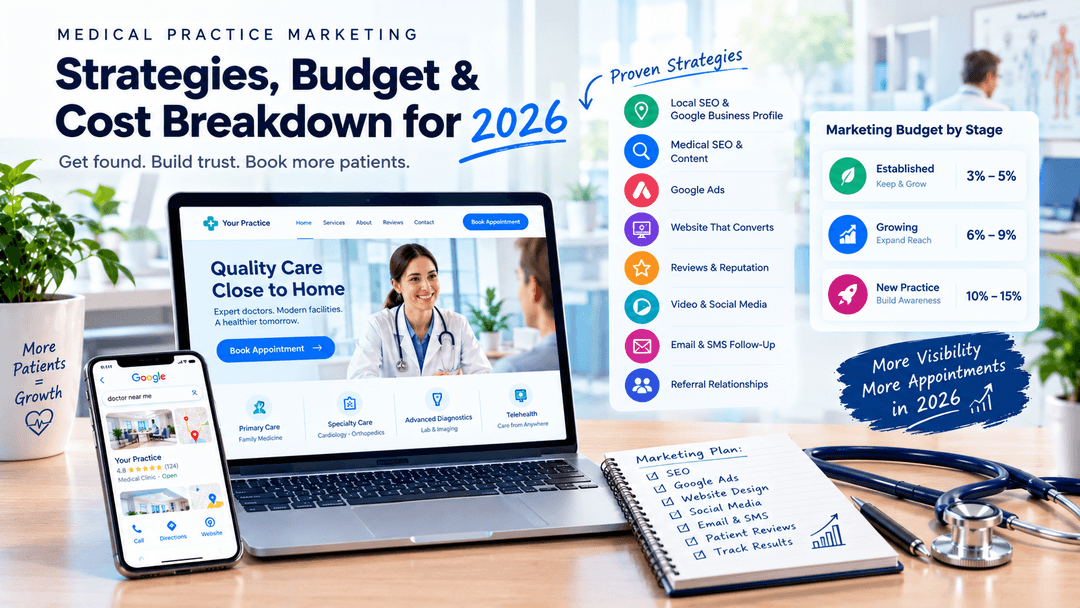
Social media is one line in a bigger plan. For budget ranges across SEO, ads, and web design, see our medical practice marketing guide to strategy, budget, and costs.
In-House vs Agency Social Media for Clinics
In-house vs agency social media for clinics comes down to control versus capacity. Your staff knows the clinic best, while an agency brings a full team and a tested process.
- In-house: high control and speed, but staff must be trained on healthcare rules, capacity is limited by one person’s time, and the cost is salary, benefits, and tools. Best for large groups with marketing staff.
- Agency: a team for strategy, design, video, and reporting, with strong compliance knowledge if the agency specializes in healthcare. The cost is a monthly retainer, and speed depends on your approval process. Best for practices without a dedicated marketing team.
A hybrid often works well: your staff provides photos, news, and physician time, while a partner handles planning, design, scheduling, and reporting.
How to Decide: Ask four questions:
- Does someone on your team have at least five hours a week for social media?
- Can they film and edit video, not just post?
- Does anyone on staff know HIPAA and advertising rules well enough to review content?
- Can you cover their work when they are away?
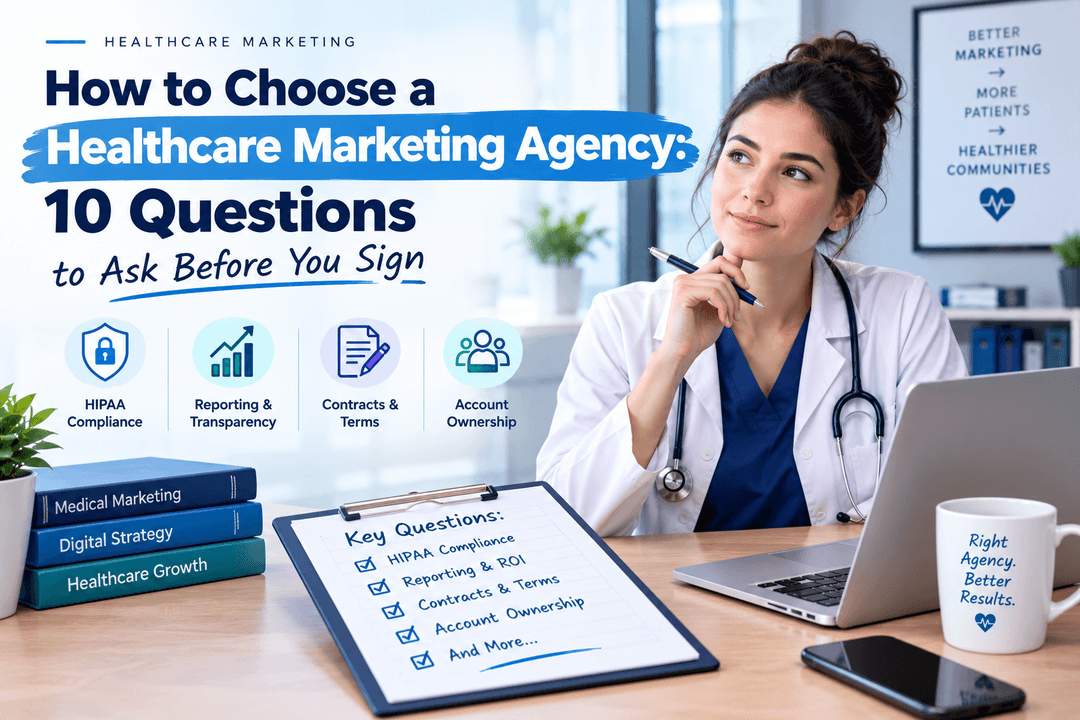
If most answers are no, outside help will probably cost less than the posts you miss. If you lean toward an agency, use these 10 questions to ask before you hire a healthcare marketing agency.
Common Healthcare Social Media Mistakes to Avoid
Most practices that give up on social media were not failing at the platform. They were making a few avoidable mistakes:
- Posting in bursts, then going silent. A steady two or three posts a week beats a daily burst that fades after a month.
- Only promoting services. Patients follow useful content, so mix education and people with offers.
- Ignoring comments and messages. Slow replies suggest the office may be slow too.
- Posting without a goal. Without one, you cannot tell what is working.
- Skipping compliance checks. One careless photo or review reply can cost far more than a month of posts.
- Using unreadable graphics. Crowded text and tiny fonts get scrolled past.
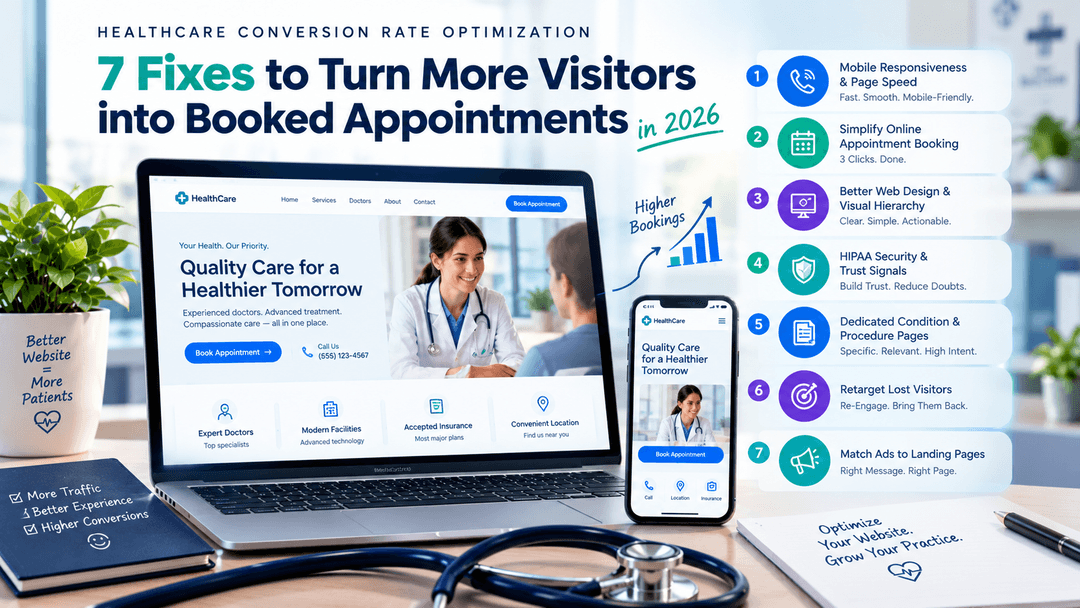
- Sending traffic to a weak page. If your booking page is slow or confusing, even good posts will not convert. A pass of healthcare conversion rate optimization on that page fixes it.
Your First 30 Days: A Launch Checklist
Week 1: Set the foundation
- Write one goal for the next 90 days
- Choose one or two platforms
- Claim and complete your profiles with the same name, logo, and contact details
- Write a short staff social media policy and a photo authorization form
Week 2: Build your content bank
- Choose four or five content pillars
- List 15 patient questions to answer
- Film six to eight short physician videos in one session
- Create two or three branded post templates
Week 3: Launch
- Schedule three posts for the week
- Add UTM links to every link you share
- Set aside 10 minutes a day to reply to comments and messages
Week 4: Review
- Check reach, engagement, clicks, and inquiries
- Keep the post types that worked and drop the rest
- Plan the next 30 days
Tracking Social Media Results
Measure what leads to appointments, not only likes. Review these numbers once a month:
- Reach and engagement rate: are the right people seeing and responding?
- Profile and website clicks: use UTM links to see which posts send visitors.
- Inquiries and calls from social: ask new patients how they heard about you.
- Booked appointments from social traffic: the number that matters most.
To see which posts bring patients, tag every link you share with a UTM code. A UTM is a short label added to the end of a web address that tells your analytics tool where a visitor came from, such as Instagram or a specific Reel. Free tools like Google’s Campaign URL Builder create these in seconds. Once bookings and form submissions are set up as tracked conversions, your analytics can show which posts sent visitors who actually booked. Also ask new patients how they found you, since some people see a post and call directly.
Likes show interest, but booked appointments show results. If people click through and do not book, the problem is usually the landing page, not the post. To compare channels by cost, learn how to calculate patient acquisition cost and lifetime value across your marketing.
Need Help With Social Media for Your Practice?
If you would rather not run this yourself, a healthcare social media marketing agency can take over planning, content, community management, and reporting. The right social media marketing company for clinics understands HIPAA, knows your specialty’s patient journey, and reports on bookings instead of follower counts.
Before you hire a social media agency for your medical practice, get clear on what is working today. Ask for a free social media audit for healthcare practices, and we will review your profiles, content, and compliance risks, then show you the fastest fixes.
FAQs
How often should a medical practice post on social media?
Two to four posts a week on one or two platforms is a realistic start. Consistency matters more than volume, so choose a pace your team can keep for at least 90 days.
Which social media platform is best for doctors?
Facebook and Instagram suit most practices because patients use them to check local providers. Add LinkedIn if referrals matter to you, and YouTube for longer procedure explainers. Start with one or two.
Can a doctor post patient photos or stories on social media?
Only with the patient’s written authorization. Remove names, record details, and anything in the background that could identify them. When you are unsure, check with your compliance contact first.
Do medical practices need to run social media ads?
No. Organic posts build trust, while ads reach people who do not follow you yet. Start with organic content and a clear landing page, then add paid ads once you know which posts and pages convert.
How long does healthcare social media marketing take to work?
Most practices need about three months of consistent work before trends become clear. Booked appointments usually follow more slowly and depend on your website and how fast you respond to inquiries. Review results monthly, not weekly.
Should doctors have personal social media accounts for their practice?
It is optional. The practice account should carry your core schedule. If a doctor also has a personal profile, keep patient information out of it, follow the same privacy and professional guidelines, and keep personal and practice content separate.
How should a practice handle negative comments on social media?
Respond calmly and briefly, never confirm that the person is a patient, and offer to talk offline. Hide or report only content that breaks platform rules, such as abuse or spam, not simple criticism.
What is the difference between organic and paid social media for medical practices?
Organic social media is the free content you post and the conversations you have with followers. Paid social uses ads to reach people who do not follow you yet. Most practices start organic to build trust, then add paid ads to reach more local patients.