


Why Your Medical Website Isn't Converting: 7 Fixes for 2026
Every day, visitors land on your website, yet very few become patients. This is the biggest "leaky funnel" in healthcare digital marketing, and fixing it is the fastest way to grow without raising your ad budget.
Many practice managers invest heavily in digital marketing for medical practices and drive hundreds of local visitors to their pages every week. Yet their appointment calendars stay flat. If your website is not converting, the problem is rarely traffic. It is almost always a gap in healthcare conversion rate optimization (CRO).
Your website is the digital front door of your clinic. If it is slow, confusing, or hard to book through, patients leave for a competitor. Below are the seven proven fixes to increase patient appointments in 2026.
Why Websites Fail to Convert: The Leaky Funnel Explained
A healthcare marketing funnel moves patients from search to visit to appointment. Leaks happen at each stage: slow pages lose visitors at the top, confusing layouts lose them in the middle, and complicated booking forms lose them at the bottom. The seven fixes below plug each leak.
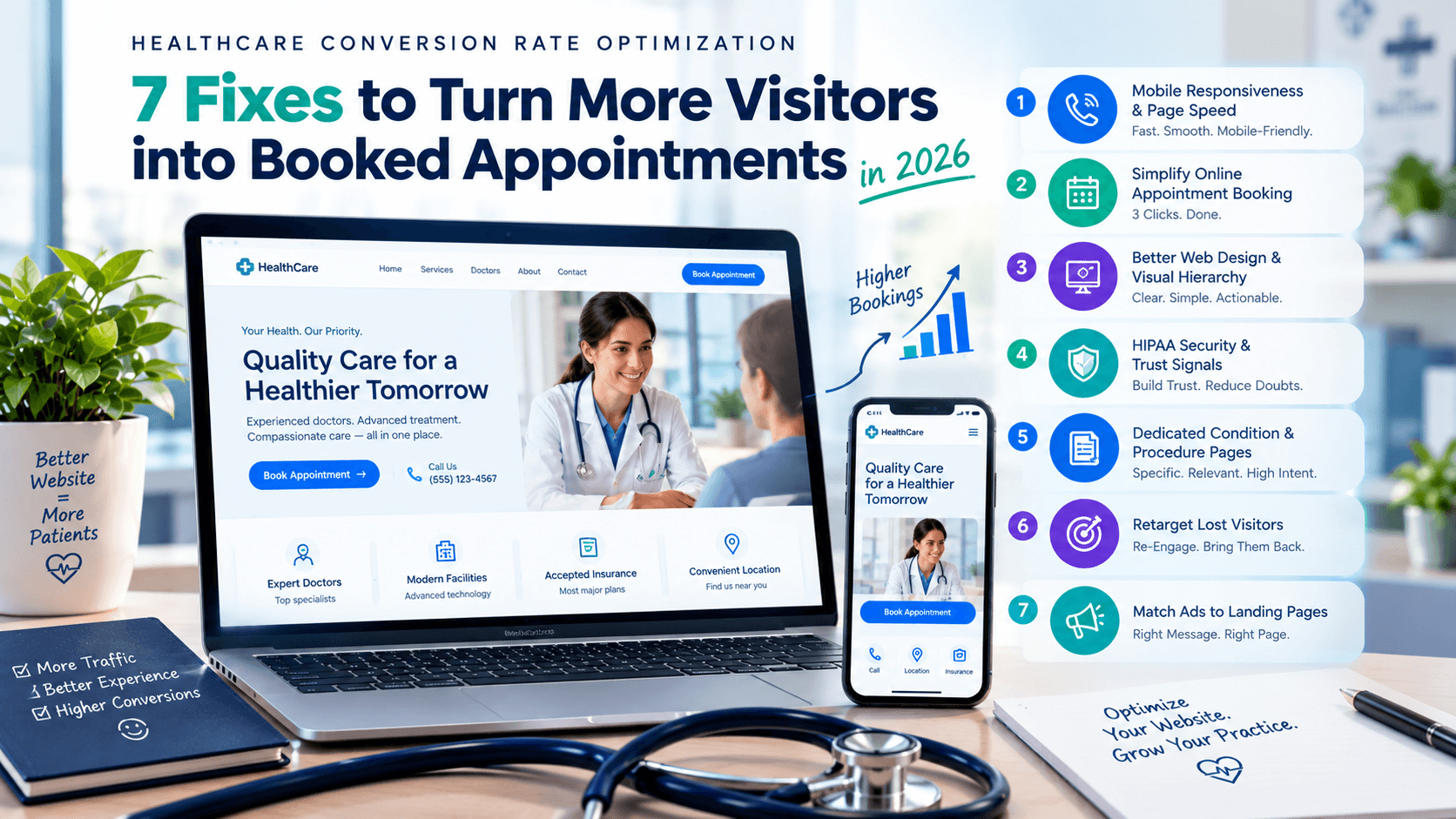
1. Fix Mobile Responsiveness and Page Speed
Most local healthcare searches happen on smartphones, often when the patient needs care quickly. If your site takes more than three seconds to load, bounce rate rises sharply. A layout that forces pinch-and-zoom destroys trust instantly.
The fix: Build a fully mobile-responsive website. Compress images, enable browser caching, and audit Core Web Vitals regularly. A fast mobile experience is the foundation of a healthy website conversion rate.
2. Simplify Online Appointment Booking
Long forms, PDF registration papers, and "we'll call you back" processes push patients away. If booking a visit takes more effort than ordering food online, conversions drop.
The fix: Add online patient scheduling software to your key pages. Let patients pick a provider, see real-time slots, and confirm in three clicks or fewer.
Clinics streamline this flow with professional healthcare website design services, which remove booking friction and increase patient intake.
3. Improve Healthcare Web Design and Visual Hierarchy
Visitors want quick answers to three questions:
- Do you treat my condition?
- Are you near me, and do you accept my insurance?
- How soon can I see a doctor?
Many medical websites bury these answers under mission statements and stock photos.
The fix: Follow healthcare website best practices. Put a clear "Book Online" button and a clickable phone number in the top header on every page, and show accepted insurance and addresses above the fold.
4. Add HIPAA-Compliant Security and Trust Signals
Patients are protective of their health information. Outdated forms or missing security indicators make them hesitate.
The fix: Use a HIPAA-compliant website design across your whole domain. Display SSL badges, medical board certifications, doctor bios, and verified patient reviews on high-converting pages.
5. Build Dedicated Condition and Procedure Pages
Putting every treatment on one generic "Services" page is a common mistake. A patient searching for "robotic knee replacement" or "clear aligners" wants a page about exactly that.
The fix: Create a long-form page for each procedure, covering recovery timeline, accepted insurance, and provider credentials.
Clinics build these pages with targeted medical SEO services, which capture qualified local searches and send patients straight to booking forms.
6. Use Retargeting to Recover Lost Visitors
Patients considering elective or specialized care often compare providers for weeks. If they leave without booking and you have no follow-up, that marketing spend is lost.
The fix: Use compliant, educational retargeting ads on Google and social platforms to re-engage visitors who viewed procedure pages without booking.
7. Match Ad Campaigns to Dedicated Landing Pages
Sending all paid traffic to the homepage creates a mismatch. If an ad promises "Emergency Pediatric Dental Care" and the visitor lands on a general homepage, they leave.
The fix: Create a tailored landing page for each campaign and match its headline to the ad's search query. This lowers patient acquisition cost and stops marketing leakage.
Explore our full range of medical marketing services to align your campaigns with high-converting pages.
How to Get More Patients for Your Medical Practice
Fixing conversion is the most cost-effective way to get more patients, because you grow from traffic you already have. Combine the seven fixes above with local SEO, Google Business Profile optimization, patient reviews, and targeted ads. Improve the website first, then scale traffic, so every new visitor has a better chance of booking.
What Makes a Good Medical Website? (Checklist)
A good medical website loads fast on mobile, makes booking possible in a few clicks, shows insurance and location clearly, builds trust with security and reviews, and has dedicated pages for each service.
Conversion Flaw
Impact
The 2026 Fix
Slow mobile loading
High bounce rate
Compress media, optimize Core Web Vitals
Complicated scheduling forms
Booking drop-offs
Real-time online appointment booking
Weak visual hierarchy
Patients can't find contact info
Sticky header with one-click calling
Missing security indicators
Privacy concerns
HIPAA-compliant forms and SSL badges
Generic services page
Low relevance and authority
Dedicated condition and procedure pages
No retargeting
Lost prospects
Compliant educational retargeting ads
Homepage ad routing
Intent mismatch
Dedicated campaign landing pages
Frequently Asked Questions (FAQs)
What is a good conversion rate for healthcare websites?
Many healthcare websites convert roughly 2% to 4% of visitors into appointments. Well-optimized sites with real-time scheduling and mobile-first design often reach higher rates.
Why do patients leave medical websites without booking?
Common reasons are slow mobile speed, complicated booking forms, unclear insurance and location information, and lack of trust signals.
How can I increase online patient appointments?
Simplify booking to a few clicks, add online scheduling, place a clear call-to-action on every page, and build dedicated landing pages for each service.
How does online patient scheduling software improve revenue?
It lets patients book 24/7, including evenings and weekends when your front desk is closed, which raises appointment volume without extra admin work.
Why is my clinic getting website traffic but no new patients?
This usually points to booking friction, slow mobile speed, or a mismatch between your ads and landing pages.
Ready to Stop the Leaks in Your Practice Website?
Your healthcare digital marketing should generate booked appointments, not wasted clicks. Healthcareketing audits, redesigns, and optimizes medical websites to turn searchers into long-term patients.
-1.png&w=1080&q=75)